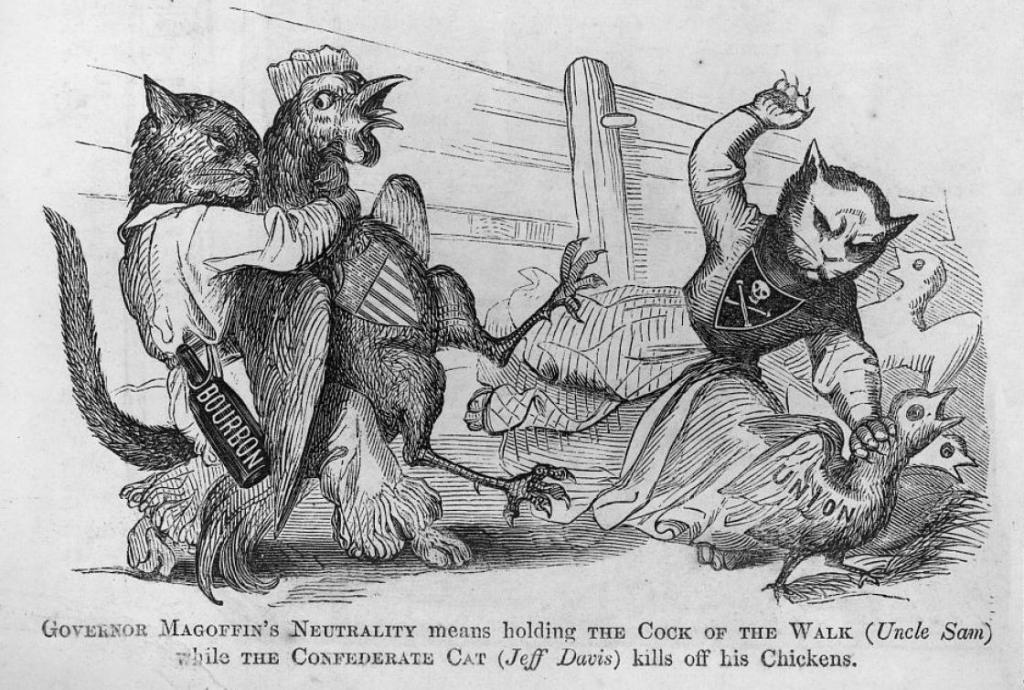
This is a Civil War story.
It’s not a story of two brothers fighting against one another, although I’ll be honest, I’m surprised by that.
The story begins with Hiram and John McLemore, my husband’s 3rd Great Uncle and 2nd Great-Grandfather, respectively.
In the 1860 census, Hiram and John are recorded as living in District 1, Logan County, Kentucky; the Rabbitsville Post Office. Today, that is about halfway between Russellville and Lewisburg. They lived in different households, having been farmed out after the death of their father in 1858. John is fifteen, Hiram one year older.
Russellville, as it happens, is in the lower third of the state, about fifteen miles from Tennessee and around twenty miles from Bowling Green, KY. This is significant because when the Civil War started, Kentucky declared itself a neutral state: those citizens living in the northern parts of the state sympathized with the Union while those in southern Kentucky supported the Confederacy. [2]
Many, including the Governor of Kentucky, were angry about this decision and on 18 November 1861, a meeting in Russellville of delegates from sixty-eight Kentucky counties passed an ordinance to create a shadow state and for that shadow state to secede and join the Confederacy. They established Bowling Green as their capital. [2]
Given Hiram’s and John’s surroundings and proximity to the Secessionist States, one would have expected them to join the rebel cause. But they both chose to fight with the Union, even though this meant fighting against their friends and neighbors. I’m sure it was not an easy decision; having a dissenting opinion in the midst of others is difficult, and harder still to stand up for one’s convictions even when those beliefs go against your neighbors.
Hiram, being the eldest of the brothers, joined the Union first. On 13 August 1862, less than a year after the shadow state joined the Confederacy, the 8th Regiment Cavalry organized in Russellville, in response to guerilla raids [2] [3] into the area, and Hiram signed up. As part of the Cavalry, his company operated against the Confederate guerillas [5], disrupting enemy maneuvers, attacking supply lines and enemy bases, and intercepting communications. [1]
John joined the conflict in February of 1864 as part of the 26th Regiment of Kentucky Infantry, Company F. As part of the infantry, John saw more hand-to-hand combat and traveled a good deal throughout the Confederate territories. [1] Initially posted in Bowling Green, in December of 1864 his unit was ordered to Nashville, then Washington, DC, and finally to the Carolinas where John finished his military duty before returning to Louisville in July 1865 and being mustered out of service. [4]
Both Hiram and John survived their military experience [6] and returned to Russellville, where they lived side by side with the very neighbors against whom they had fought during the war.
I wonder if that caused any problems for the brothers?
Sources and Notes
- Differences between Infantry and Cavalry units in the Civil War, by Michael O’Neill
- Kentucky in the American Civil War
- Confederates abandoned Bowling Green on 11 February 1862, after which Confederate General John Hunt Morgan began his raids into the state.
- As part of the 26th Regiment, John engaged in the Battle of Nashville (Dec 15-16, 1864), the Capture of Wilmington (Feb. 22, 1865), the Campaign of the Carolinas (March 6-21), and the Advance and Occupation of Raleigh (April 10-14, 1865); 26th Regiment Kentucky Volunteer Infantry
- 8th Regiment Kentucky Volunteer Cavalry
- John met and married Mary Jane Maben in July of 1881 and celebrated the birth of their first child, Cyrus Guy McLemore, in April of 1883. Cyrus would eventually marry Nettie Nobia McPhaill and move to Jennings, Louisiana, bringing his parents, John & Mary Jane, and his children–James, Malcolm, Clifford, Anna May, and Ruth.
- Header Image: Kentucky Cat Fight. “Governor Magoffin’s [Kentucky governor] neutrality means holding the cock of the walk (Uncle Sam) while the Confederate cat (Jeff Davis) kills off his chickens.” – Harper’s Weekly, 1861; Library of Congress


Leave a Reply